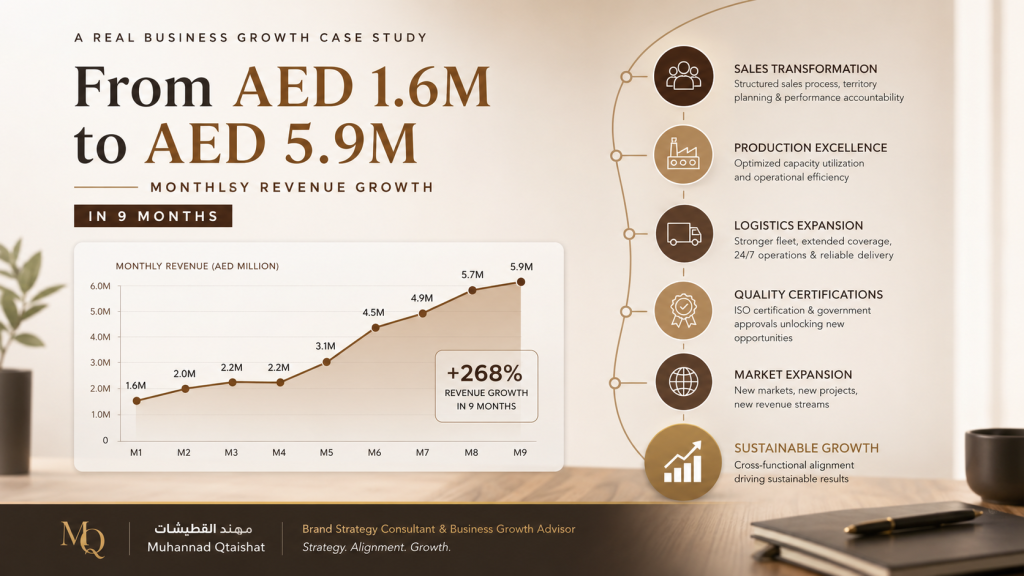
Business Growth Case Study by Muhannad Qtaishat (مهند القطيشات) demonstrating strategic alignment between sales, production, logistics, and quality management.
In 2008, I was assigned to help lead the growth of a large cement products manufacturing company operating under a diversified holding group. At the time, the company generated approximately AED 1.6 million in monthly revenue despite having a production capacity capable of supporting significantly higher sales volumes. The challenge was clear: transform operational potential into measurable business growth through strategic planning, cross-functional alignment, and disciplined execution.
The Initial Business Challenge
Despite having high-quality products, competitive pricing, and an experienced sales team, the business faced multiple structural challenges. Sales representatives operated without a clear territory strategy, logistics capacity was insufficient for expansion, quality certifications were missing, and operational departments were not fully aligned around a common growth objective.
Strategic Diagnosis and Growth Framework
Rather than focusing on short-term sales tactics or price reductions, the first step was to conduct a comprehensive assessment of the business model, operational constraints, market coverage, logistics capacity, sales effectiveness, and quality assurance capabilities. The objective was to identify the true bottlenecks preventing the company from utilizing its available production capacity.
Key Findings
- Sales representatives were operating without measurable weekly objectives.
- No structured territory management strategy was in place.
- Delivery fleet capacity was insufficient to support aggressive growth.
- Driver availability limited operational flexibility.
- The company lacked quality certifications required for larger projects.
- Competition was primarily based on price reductions rather than value creation.
- Cross-department coordination was weak.
- Decision-making depended heavily on a factory manager responsible for multiple companies within the holding group.
The First Strategic Decisions
- Establish measurable weekly sales targets and daily management meetings.
- Divide the market into geographic territories and assign clear ownership to each sales representative.
- Launch a quality certification program including ISO and government approvals.
- Expand logistics capacity through additional drivers, trucks, and third-party transportation support.
- Implement a 24/7 logistics and delivery operation.
- Standardize pricing and reduce dependency on discount-driven selling.
- Improve communication and coordination across sales, production, logistics, finance, and HR.
Revenue Growth Timeline
Monthly Revenue Performance (AED Million)
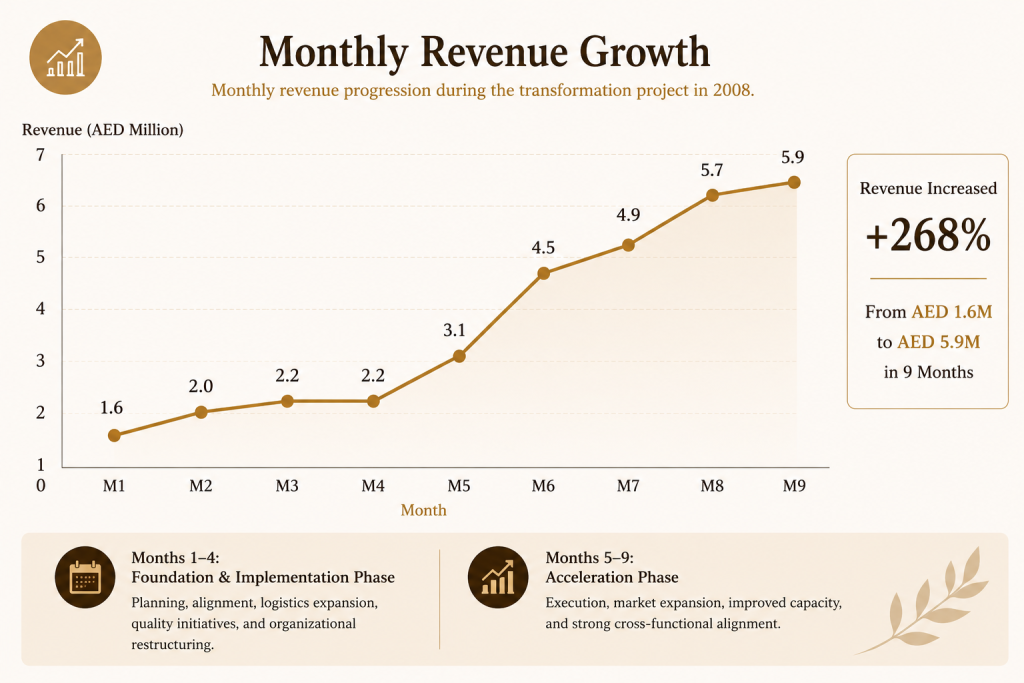
One of the most important observations during this transformation was that growth did not happen immediately. The first months were dedicated to planning, organizational alignment, logistics expansion, quality certification initiatives, and building the operational foundations required to support sustainable growth. The accelerated growth observed in later months was the result of decisions implemented much earlier.
| Revenue (AED Million) | Month |
| 1.6 | 1 |
| 2.0 | 2 |
| 2.2 | 3 |
| 2.2 | 4 |
| 3.1 | 5 |
| 4.5 | 6 |
| 4.9 | 7 |
| 5.7 | 8 |
| 5.9 | 9 |
The relatively flat performance during months three and four reflected the implementation phase of the transformation. During this period, significant effort was invested in logistics expansion, quality certification programs, sales restructuring, and cross-functional coordination. Once these foundations were established, revenue growth accelerated significantly.
Cross-Functional Alignment: The Real Growth Driver
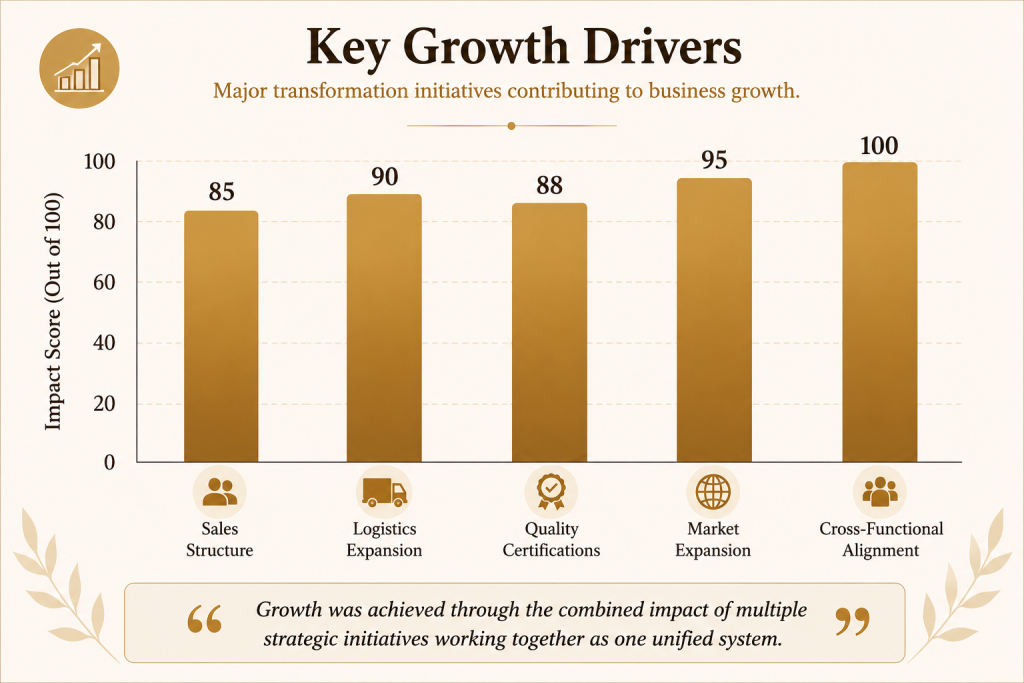
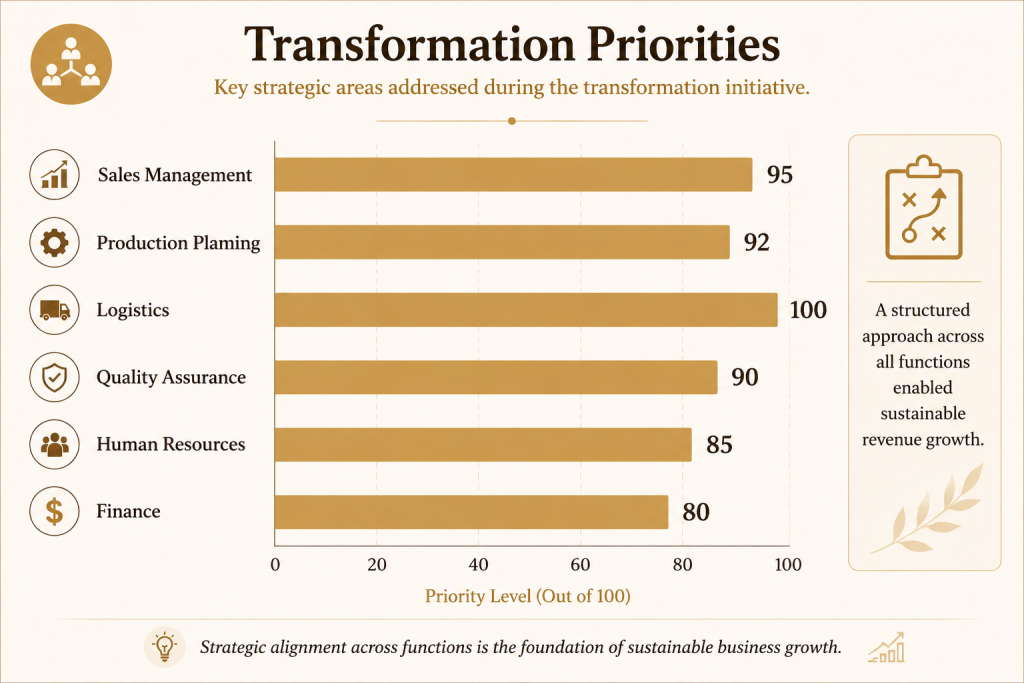
While revenue growth is often attributed to sales performance, the most significant breakthrough in this transformation came from cross-functional alignment. Sustainable growth became possible only when sales, production, logistics, quality management, finance, and leadership began operating as a unified system rather than independent departments.
Breaking Departmental Silos
One of the most challenging aspects of the transformation was overcoming departmental silos. Different teams had different priorities, objectives, and expectations. Some managers questioned the feasibility of the growth targets, while others were concerned about the pace of expansion. Success required creating a shared vision and ensuring that every department understood its role in achieving the overall business objectives.
Aligning Capacity with Demand
Revenue growth was not driven solely by increasing customer demand. It required simultaneous improvements in production readiness, logistics capacity, workforce planning, quality assurance, and delivery reliability. Each function had to scale in coordination with the others to avoid creating operational bottlenecks.
Sustainable growth is rarely the result of a single department. It is the outcome of strategic alignment, operational discipline, and coordinated execution across the entire organization.
Building a High-Performance Culture
Sustainable growth requires more than systems, processes, and strategies. It requires people who are motivated, engaged, and committed to achieving shared objectives. As the transformation progressed, it became clear that organizational performance could not improve without creating a direct connection between business success and employee success.
Aligning Incentives with Business Objectives
In collaboration with Human Resources and Finance, a revised performance and incentive framework was introduced to support the growth strategy. The objective was to create an environment where employees could directly benefit from the company’s success while maintaining accountability for results.
- Enhanced sales commission structures.
- Performance-based incentive programs.
- Overtime compensation for operational teams.
- Recognition mechanisms linked to business performance.
- Greater accountability through measurable objectives.
Creating Shared Ownership of Results
As operational performance improved and revenue increased, employees began to see tangible benefits from the transformation. Salary levels increased, commission opportunities expanded, and performance-based rewards reinforced a culture of accountability and continuous improvement. This helped strengthen engagement across departments and encouraged teams to work toward common business goals rather than isolated departmental targets.
One of the most valuable lessons from this experience was that people support what they help build. When employees understand the strategy, contribute to execution, and participate in the rewards of success, organizational transformation becomes significantly more sustainable.
High-performing organizations are built when employees see a clear connection between their daily efforts and the long-term success of the business.
KPI Framework and Performance Measurement
Sustainable growth cannot be managed through assumptions alone. One of the key components of the transformation was the implementation of a structured KPI framework that provided visibility into performance, identified bottlenecks, and supported data-driven decision-making. These indicators enabled management to monitor progress, evaluate execution, and maintain alignment between short-term activities and long-term objectives.
Key Performance Indicators Used During the Transformation
- Revenue Growth Rate.
- Salesperson Productivity.
- Production Utilization Rate.
- Customer Retention Rate.
- Order-to-Delivery Cycle Time.
- Forecast Accuracy.
- Delivery Reliability.
- New Customer Acquisition Rate.
Why Measurement Matters
Performance measurement was not implemented as a reporting exercise. It was used as a management tool. The KPI framework helped identify operational constraints early, improve accountability, strengthen coordination between departments, and ensure that growth initiatives remained aligned with the overall strategy.
What gets measured gets managed. What gets managed consistently becomes scalable.
Data-Driven Decision Making
As the transformation progressed, management decisions became increasingly data-driven. Revenue trends, operational capacity, logistics performance, customer feedback, and sales productivity were reviewed regularly to support timely decision-making and continuous improvement. This reduced reliance on intuition and improved organizational responsiveness.
The Most Important Lessons Learned
Looking back at the transformation, the most valuable lessons were not related to sales techniques, pricing strategies, or operational procedures alone. The experience reinforced several fundamental principles that apply to businesses across industries and growth stages.
- Growth Begins with Strategy
Sustainable growth starts with a clear strategy supported by measurable objectives, realistic execution plans, and organizational alignment.
- Sales Alone Cannot Drive Sustainable Growth
Revenue growth depends on the ability of operations, logistics, quality, finance, and leadership to support increased demand.
- Teamwork Outperforms Individual Effort
Organizations achieve exceptional results when departments operate as a unified system rather than isolated functions.
- Continuous Improvement Creates Competitive Advantage
Businesses that continuously improve their people, processes, and systems are better positioned to scale and adapt to changing market conditions.
- Leadership Requires Visibility and Accountability
Growth accelerates when leaders establish clear expectations, monitor performance, and maintain accountability across the organization.
Revenue growth was the visible outcome. The real transformation occurred behind the scenes through operational restructuring, logistics expansion, quality certification initiatives, and cross-functional alignment across the entire organization.
Final Thoughts
Many organizations possess significantly greater growth potential than their current results suggest. In many cases, the challenge is not the market, the product, or even the sales team. The real challenge lies in fragmented execution, operational bottlenecks, limited coordination, and the absence of a structured growth strategy.
The transformation described in this case study was not the result of a single initiative or department. It was the outcome of strategic planning, cross-functional alignment, disciplined execution, and a shared commitment to achieving a common objective.
The increase in monthly revenue from AED 1.6 million to AED 5.9 million over nine months was ultimately a reflection of what can happen when people, processes, systems, and leadership work together toward a clearly defined goal.
Sustainable growth is rarely accidental. It is designed, managed, measured, and continuously improved.
Sustainable growth is not achieved by working harder. It is achieved by aligning strategy, people, processes, and execution around a common objective.
نبذة عربية عن الدراسة
تستعرض هذه الدراسة حالة عملية حقيقية قادها مهند القطيشات، خلال عام 2008 في أحد مصانع المنتجات الإسمنتية التابعة لمجموعة شركات تجارية كبرى في دولة الإمارات العربية المتحدة، حيث تم تنفيذ استراتيجية نمو متكاملة ساهمت في رفع المبيعات الشهرية من 1.6 مليون درهم إلى 5.9 مليون درهم خلال تسعة أشهر من خلال مواءمة أقسام المبيعات والإنتاج واللوجستيات والجودة ضمن إطار استراتيجي موحد
إعداد: مهند القطيشات
Muhannad Qtaishat
If your business is facing growth challenges despite having strong products or market demand, strategic alignment may be the missing piece.
For strategic consulting inquiries:
Contact via mqtaishat.com
About the Author

Muhannad Qtaishat is a Brand Strategy Consultant, Business Growth Advisor, and Marketing Professional with extensive experience in business transformation, strategic planning, sales development, operational excellence, and scalable growth strategies across multiple industries in the Middle East.
مهند القطيشات هو استشاري استراتيجيات العلامات التجارية وتطوير الأعمال، متخصص في بناء استراتيجيات النمو، تحسين الأداء التشغيلي، تطوير المبيعات، وتحويل الأفكار والمشاريع إلى علامات تجارية قابلة للنمو والتوسع
Read more insights by Muhannad Qtaishat on www.mqtaishat.com